

Welcome to Plastic-Free Kitchen Week on the Strategist, where we’ve been obsessively researching and testing plastic alternatives — for everything from appliances to cleaning supplies to cookware. For more, head to our Plastic-Free Kitchen Week hub.
In my guide to nonstick skillets, which I wrote several years ago, I declared that ceramic coatings simply don’t work that well.
But since I’ve become increasingly aware of all the microplastics making their way into our bodies, I’ve also become one of many people thinking about how to reduce my exposure to them. Even if entirely eliminating them from my life is impossible, I’d like to exert some control where I can.
To be fair, I was always careful with my regular nonstick pans. I never touched their surfaces with metal utensils or abrasive sponges, I did my best to avoid extremely high heat, and I tossed them if there were any signs of wear (which is inevitable after a handful of years).
It also should be said: Ceramic nonstick cookware is underregulated and, at this point, still fairly understudied. Brands can easily slap terms like “nontoxic” onto their marketing materials for ceramic nonstick pans when that doesn’t really mean anything. Ceramic coatings are supposed to be made from silica- or sand-based sol-gel that is treated to provide a similar easy-release effect as their PTFE-ridden counterparts — but other chemicals those processes might involve are often undisclosed. These coatings are also notoriously short-lived, not even lasting as long as conventional nonstick.
Even after all that, ceramic nonstick still seems increasingly tempting as we find out more about the potential harms of PTFEs. To that end, I vowed to reset my bias against it and test out some popular models over the past many months. I’m pleased to report that my mind has mostly changed.
I still stand by my original take that nonstick coatings with PTFEs simply do work a bit better (and no nonstick skillet I’ve ever used has maintained a smooth surface as well and for as long as my Zwilling Madura pans), but that said, there are totally good ceramic nonstick options out there. In general, I found that the ones I wrote about here all perform at about the same level, and the main differences are in design and price, which I’ve called out in the superlatives below.
A bit about my testing: Most of the models I recommend here I’ve used dozens and dozens of times each. (And if I’ve used one less than that, I say so.) I eliminated a few pans (also listed below, for reference) after several trials where I determined they simply weren’t as good as my final four favorites, and therefore not worth including. I primarily made scrambled eggs and omelets — to me, the ultimate tests, as I believe these are the only things that truly benefit from a nonstick surface. And I only ever used silicone utensils with these skillets and hand-washed them.
Best-designed ceramic nonstick skillet

New! You can now save this product for later.
Made In’s skillet was the first to convince me that ceramic nonstick could work well. I’ve had the ten-inch (it also comes in a smaller eight-inch and a larger 12-inch) in my collection for nearly a year now, which means I’ve also used it more than any other model on this list. And while it’s the most expensive of the bunch, it’s still working quite well — pretty much the ultimate good sign in my book, as no version of nonstick pans is meant to last forever. Of course, the longer it holds up, the more you get your money’s worth.
Beyond performance, the design gives it an edge. The handle (which comes in silver or an antique brass finish) is rounded, but has a very shallow divot at the top, a natural place to comfortably rest your thumb when you’re gripping it. The handle also has a slight bend upward from the point at which it’s attached to the body that makes it feel balanced when you lift it up or maneuver it around the stovetop. It’s bracketed on tightly and overall not too heavy.
The surface heats evenly. Possibly this is because the entire outside of the pan is metal, whereas the others have coatings either all the way around or surrounding just a circle on the bottom. And a small detail I appreciate: The edge of the pan is the only one on this list that is rolled, which makes it possible to pour or slide food out when you’re finished cooking (like, for example, a sunny-side-up egg).
Best less-expensive ceramic nonstick skillet

New! You can now save this product for later.
Caraway’s pan, which is just a bit cheaper, has also worked great so far. It heats evenly and has held its nonstick surface for the six months or so I’ve been using it. I don’t think it looks as sophisticated as the Made In, but that’s a personal preference.
The handle on this one is shorter, even more rounded, and sticks directly outward. There’s an eight-inch and a larger 10.5-inch. While Made In’s middle size is listed at ten inches, the actual cooking surface area — and the metal underneath that conducts heat — is a bit smaller on Caraway’s. The walls are about half an inch higher. The slope of the inside is even smoother than Made In’s, especially noticeable when I’m swooping big ribbons of scrambled eggs.

Best even-less-expensive ceramic nonstick skillet
New! You can now save this product for later.
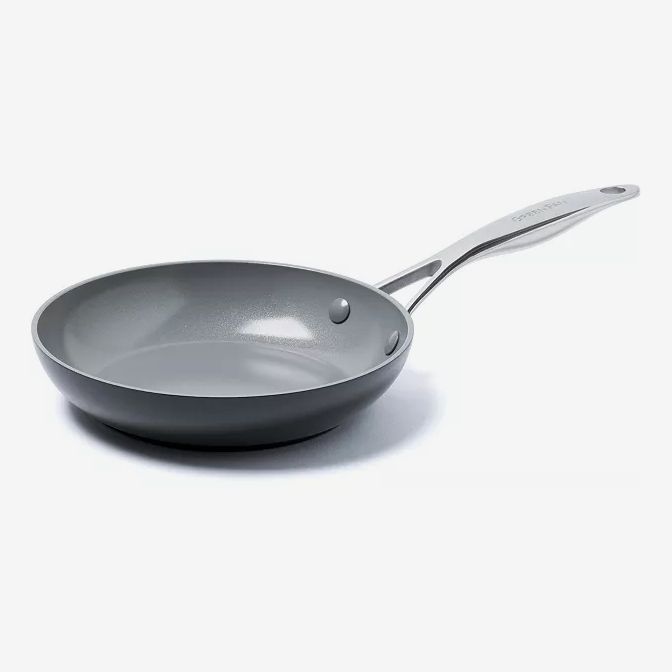
GreenPan makes a lot of ceramic nonstick cookware. When trying to figure out which lines to test, I asked the brand itself what was most popular. Their GP5 Stainless Collection skillet was one answer — which I didn’t end up loving. It has a five-layer body made from stainless steel sandwiched around aluminum, like most stainless-steel skillets, covered with one of several different nonstick-coating makeups the brand uses for its various pans. I found it to be heavy, and it was harder to control the heat with this one, which led to some sticking from the very beginning. Not to mention, it’s more expensive.
But the Valencia Pro — which was not only recommended by GreenPan, but also by several experts during my original nonstick-skillet reporting — is great. It’s much more reasonably priced than the GP5 but also costs less than the Caraway and the Made In. With a pan that will eventually stop working as it’s supposed to, that’s a big selling point in my book.
Still, I’ve had this one for about four months and it is still as nonstick as the day I got it. My spatula glides through no problem. And again, the surface heats evenly.
In terms of looks, it’s my least favorite of the bunch: It feels like the design details weren’t quite as thought out as with the others. The handle is fine but a bit chunky and shorter than even the Caraway. It weighs 2.3 pounds — just a bit less than the other two — but it still feels sturdy on the stove. And most importantly, it heats evenly and the nonstick coating works well.
One disclaimer: The brand claims all its skillets are metal-utensil safe, but if you want to get the most longevity out of yours, I would recommend sticking to silicone and wood utensils.
Best budget ceramic nonstick skillet

New! You can now save this product for later.
I’ll be honest: I’m shocked by how well this pan works. It’s not just that it’s the cheapest option I tested, but that I’m overall a bit skeptical of the company. Don’t get me wrong: Quince makes plenty of stuff worth buying. It’s just that cookware has never been a department of the brand’s we’ve recommended — and quite frankly, it seems like one of the more out-of-left-field ones.
I will preface my review with a fairly big disclaimer, which is that I’ve only been using this pan for about a month, which is significantly less time spent than with the three above. But I’ve been using it nearly every day in an attempt to give it its due — so it’s not as if it hasn’t seen a decent amount of wear. And though it may not last (I’m going to keep using it, and I’ll keep you updated), I can say that from out of the box until now, it has performed beautifully (and notably better than the few options I eliminated earlier on).
To me, it looks like a clear knock off of Caraway’s pan in terms of design (a classic Quince move) but for less than half the price. (There’s a ten-inch size, too.) The slope of the inside is smooth, the handle is comfortable and feels well attached to the body, and yet again, nothing — at least so far — sticks.

Other ceramic nonstick skillets I tested
As I said, GreenPan’s GP5 didn’t have as nonstick of a surface as its Valencia Pro. Though I’m a huge fan of many OXO products, the brand’s Ceramic Nonstick Professional Fry Pan didn’t cut it for me. It also had some issues sticking after a few times of use. The Great Jones Large Fry had the worst sticking issues of any pan on this list from the very first time I used it. Especially for a price in line with that of the Made In and Caraway, that one was a pass.
More From This Series
- Ask the Strategist: Your Most Ultraspecific Plastic-Free-Kitchen Queries
- Welcome to Plastic-Free Kitchen Week
- Replace This With That: An Exhaustive List of Plastic-Free Kitchen Swaps
- Very Pleased With My Teflon-Free Ceramic Waffle-Maker
The Strategist is designed to surface useful, expert recommendations for things to buy across the vast e-commerce landscape. Every product is independently selected by our team of editors, whom you can read about here. We update links when possible, but note that deals can expire and all prices are subject to change.


